The Future Doesn’t Change in a Day. It Changes with Every Click.
Essay | HNT Society
“The most dangerous revolutions are the ones no one recognizes as revolutions.”
No one set out to change the world.
And yet, the world is changing.
Not through a coup.
Not through a war.
Not through a single brilliant algorithm.
But through billions of small decisions.
A swipe.
A click.
A like.
A search query.
A navigation request.
A purchase recommendation.
Each individual action seems insignificant.
Together, they become the raw material of a new reality.
The Quietest Revolution in Human History
We tend to imagine revolutions as loud.
Barricades.
Demonstrations.
Manifestos.
Sirens.
History books.
Yet the digital revolution often has neither heroes nor battlefields.
It does not transform institutions first.
It transforms habits.
And habits transform societies.
Not overnight.
But gradually.
Almost imperceptibly.
The Power of Small Changes
For decades, psychology and behavioral science have shown that human decisions are profoundly influenced by context. Small changes in the way information is presented, in default settings, or in the order of available options can measurably shape behavior. In behavioral economics, this phenomenon is described, among other concepts, through the idea of nudging.
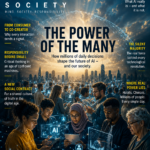
Digital platforms do not necessarily employ these mechanisms with manipulative intent. More often, they optimize for metrics such as relevance, user satisfaction, or engagement. Yet even well-intentioned optimization can produce unintended societal consequences. When millions of people interact with the same systems every day, small individual effects accumulate into large-scale social change.
HNT Reflection
The question is not whether algorithms influence our decisions.
The question is whether we recognize when they do.
Attention is not a by-product.
It is the infrastructure of the digital society.
Whoever directs attention,
directs learning.
Whoever directs learning,
shapes memory.
Whoever shapes memory,
shapes culture.
That is why attention is no longer merely a private resource.
It is a public good.
The Quiet Architecture of Everyday Life
No algorithm forces us
to watch a video.
No algorithm forces us
to adopt an opinion.
No algorithm forces us
to share an article.
But algorithms often influence
which possibilities we encounter first.
Which topics become visible.
Which voices gain reach.
Which ideas quietly fade into the background.
This process is not the same as censorship.
It is a form of structuring attention.
Precisely because of that, it deserves public discussion and transparent governance.
HNT Insight
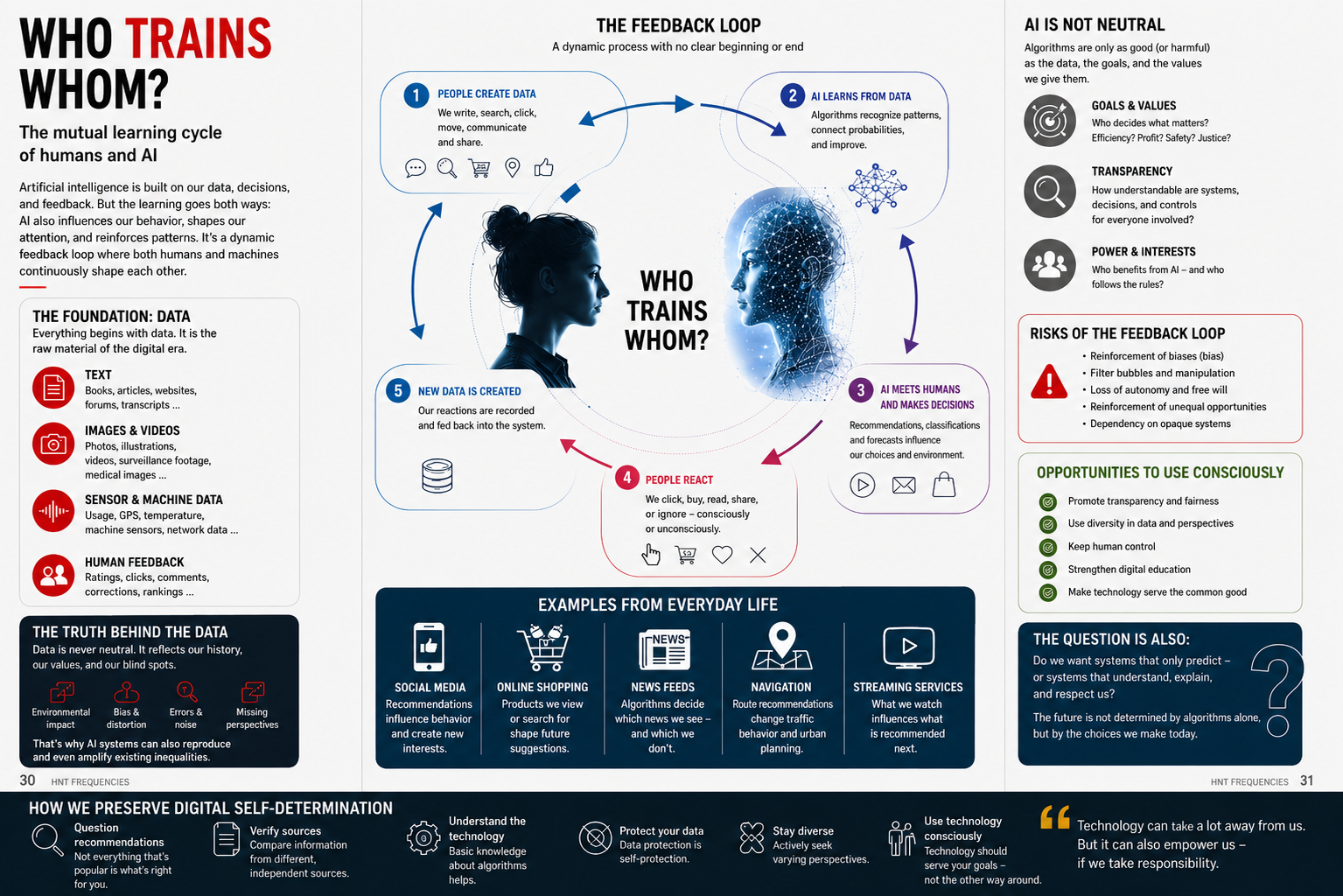
Feedback Loops—Simply Explained
People act.
Digital systems measure that behavior.
Models adjust their predictions.
Recommendations influence future behavior.
New data is created.
The cycle begins again.
Not as a conspiracy.
But as a system dynamic.
Revolution Begins in Everyday Life
We often wait for the great turning point.
For the moment
when everything changes.
Perhaps it never comes.
Perhaps the real revolution begins
when we choose
to become more conscious of our everyday decisions.
Not against technology.
But with responsibility.
Not against innovation.
But in favor of informed, independent judgment.
HNT Manifesto
We believe
that technological progress does not automatically become social progress.
We believe
that transparency is more valuable than perfection.
We believe
that critical thinking is not a nostalgic virtue,
but a cornerstone of democracy.
We believe
that machines can process information,
but responsibility remains fundamentally human.
And we believe
that a free society will not fail
because machines learn.
It will fail
if people stop
asking questions.
Final Reflection
Perhaps the history of the twenty-first century will not be remembered for the moment the first truly intelligent machine emerged.
Perhaps it will be remembered for whether we were wise enough to shape its development together.
Because the future is not a product of algorithms.
It is the result of human decisions.
Every day.
Again and again.
Selected References
- Crawford, K. (2021). Atlas of AI: Power, Politics, and the Planetary Costs of Artificial Intelligence.
- Gigerenzer, G. (2021). How to Stay Smart in a Smart World.
- Kahneman, D. (2011). Thinking, Fast and Slow.
- National Institute of Standards and Technology (NIST). (2023). AI Risk Management Framework (AI RMF 1.0).
- Thaler, R. H., & Sunstein, C. R. (2008). Nudge: Improving Decisions About Health, Wealth, and Happiness.
- UNESCO. (2021). Recommendation on the Ethics of Artificial Intelligence.
- Zuboff, S. (2019). The Age of Surveillance Capitalism.