Title: “Who Is Training Whom? – AI, Responsibility, and the Power of the Collective”
Duration: Approximately 4 minutes
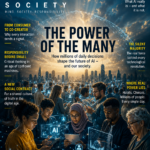
Note: The following conversation is fictional. It is intended as a journalistic exploration of the themes presented in the HNT cover story.
Florentine:
Jeff, for years we’ve been talking about social change, democracy, and responsibility. Now, suddenly, everyone is talking about artificial intelligence. What keeps bothering me is a very simple question: Why do we act as if AI is something that simply happens to us? Isn’t this the same excuse we’ve used for other major challenges—the constant belief that individuals can’t really make a difference anyway?
Jeff:
I think because it’s convenient. If a development is perceived as a force of nature, we don’t have to take responsibility for it. But technology is not a force of nature. It is designed, funded, regulated, and used by people. Behind every technological system are human decisions. And that means people can change those systems as well.
Florentine:
Then I don’t understand why we almost exclusively talk about how companies train AI. Shouldn’t we instead be talking about what we feed these systems every single day? If millions of people share unverified claims, reward outrage, and confuse attention with truth, why do we expect machines to produce something better?
Jeff:
That’s the uncomfortable part of the conversation. We criticize the outcomes while ignoring the causes. AI learns from the public knowledge ecosystem. It absorbs the patterns that society creates. Of course, companies have technical safeguards and clear responsibilities. But the quality of public discourse remains a responsibility shared by society as a whole.
Florentine:
Doesn’t that also mean we’ve settled into a rather comfortable victim mentality? We point at algorithms even though we’re the ones deciding what to publish, what to read, and what to share.
Jeff:
I’d be careful about turning that into a question of individual blame. Responsibility is not the same as guilt. Democracy only works when people recognize their own role in shaping developments. That’s true for many societal challenges—and certainly for the digital world.
Florentine:
There’s something else that bothers me. We constantly talk about the intelligence of machines. Why do we so rarely talk about the quality of our own thinking? Sometimes it feels as though we’re hoping AI will solve problems that we’ve stopped being willing to discuss seriously ourselves.
Jeff:
That would indeed be a dangerous expectation. Technology can support decision-making. It can organize information. But it cannot replace political responsibility or democratic deliberation. Anyone who believes societal decisions can simply be automated has misunderstood both democracy and technology.
Florentine:
Then perhaps the real question isn’t whether AI will change our future. It’s whether we’re willing to shape the conditions that define that future ourselves. That also means learning again to live with uncertainty, to verify sources, and to stop treating disagreement as a personal attack.
Jeff:
Exactly. And perhaps we should stop treating every technological debate like a race. The decisive competition is not between humans and machines. It’s between an open society and a comfortable one. An open society depends on people accepting responsibility. A comfortable society waits for someone else to do it.
Florentine:
Maybe that’s the central message of this cover story. Not, “Be afraid of AI.” But rather, “Take yourselves seriously again.” Because machines learn from what we leave behind. So the question isn’t only what models we build. It’s what kind of society we offer those models to learn from.
Jeff:
And that decision doesn’t begin in a data center. It begins with every one of us—every time we choose whether to contribute to understanding or simply add to the next echo.
Florentine:
Then perhaps we haven’t even asked the most important question yet: If billions of people help shape the public knowledge space every single day, why do we still behave as though we’re merely spectators?