“The future depends on what we do in the present.”
— Mahatma Gandhi
We often tell the story of artificial intelligence through its inventors—through technology companies, billion-dollar investments, supercomputers, and ever more powerful models. The headlines belong to the few who build these systems.
But history has rarely been written by inventors alone.
It has been written by millions of people who decided how a new technology would actually be used.
The Internet did not become humanity’s greatest knowledge infrastructure simply because it existed. It became one because billions of people began exchanging information, learning from one another, debating ideas, and collectively building knowledge.
The smartphone did not change the world because it had a touchscreen.
It changed the world because people changed the way they lived.
Artificial intelligence now stands at precisely the same moment.
Its future will not be determined by its existence.
It will be determined by how we choose to use it.
The Silent Majority Decides
Every day, millions of people open an AI assistant.
They proofread documents.
They translate texts.
They generate ideas.
They write software.
They prepare lessons.
They summarize scientific research.
Each individual action seems insignificant.
Yet together, these actions form an extraordinary movement.
Just as a river is not created by a single drop but by countless streams flowing together, societal change emerges from millions of everyday decisions.
The true power of artificial intelligence therefore lies not only in its algorithms.
It lies in its adoption.
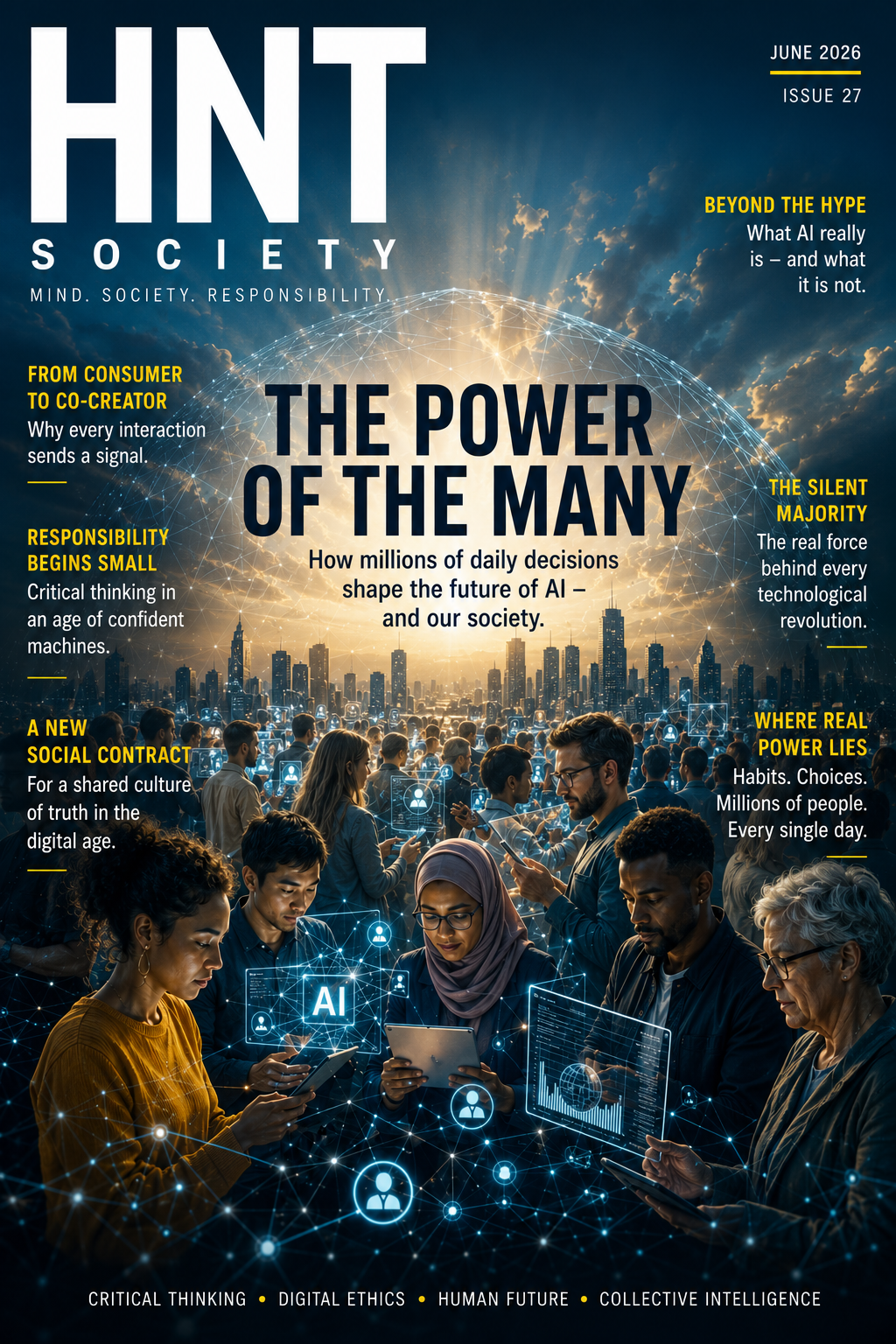
The Power of the Many
Every generation experiences moments when large numbers of people change the course of history together.
Mass demonstrations do not begin with hundreds of thousands.
They begin with a handful of people willing to take the first step.
Elections are not decided by a single ballot.
They are decided by millions of votes.
Charitable campaigns save lives because countless people contribute small amounts.
Open encyclopedias exist because thousands of individuals freely share what they know.
The evolution of artificial intelligence follows a similar pattern.
Not every individual prompt changes an AI model directly. Modern systems are trained, evaluated, and updated through carefully controlled development processes. Yet the collective patterns of use reveal to researchers and companies which problems matter most, which capabilities people need, and what expectations society has of this technology.
Direction emerges from the whole.
Not from any single interaction.
Responsibility Begins with Small Decisions
Every transformative technology changes not only what we can do, but also what we are responsible for.
In the past, it was enough to know how to operate a computer.
Today, that is no longer sufficient.
Anyone who uses artificial intelligence must also exercise judgment.
Answers should be questioned.
Sources should be verified.
Uncertainty should be recognized.
AI often communicates with remarkable confidence.
But confidence is not the same as correctness.
The more naturally machines communicate, the more important a profoundly human capability becomes:
critical thinking.
From Consumer to Co-Creator
The word user suggests passivity.
One simply uses a tool.
A hammer does not change because someone swings it.
A typewriter learns nothing from its owner.
A calculator develops no new abilities.
Artificial intelligence is different.
It does not evolve during a single conversation. Yet millions of conversations reveal what people want to accomplish, where systems fall short, and which capabilities will matter in the future.
Every user sends a signal.
Millions of users define a direction.
In this sense, the consumer becomes a co-creator.
Not because they write the source code.
But because their collective behavior helps shape the future of the technology.
A New Social Contract
Perhaps artificial intelligence does not require a contract between humans and machines.
Perhaps what our society truly needs is a new contract among human beings.
A shared commitment to
how we verify knowledge,
how we correct mistakes,
how we evaluate sources,
how we confront misinformation,
and how we take responsibility for our shared information ecosystem.
Every unverified claim can spread to millions.
But so can every carefully verified fact.
Each of us contributes to the culture of knowledge we create together.
Where the Real Power Lies
We often overestimate the power of the few.
And underestimate the strength of the many.
Great transformations rarely begin with spectacular events.
They begin with habits.
When teachers cultivate critical thinking.
When scientists communicate openly.
When journalists investigate with rigor.
When developers build transparently.
When individuals refuse to share information they have not verified.
Then it is not only our public knowledge ecosystem that changes.
The very foundation upon which future artificial intelligence is built begins to change as well.
The future will not be programmed exclusively inside data centers.
It will be written every day by millions of people.
Quietly.
Almost unnoticed.
Yet with a force greater than any single machine.
HNT Thesis
Not every prompt changes an AI model.
But millions of responsible human decisions shape the direction in which artificial intelligence—and with it, our society—will evolve.